
When the Numbers Are Not Yet the Story: Leadership in the First Hours of a Crisis
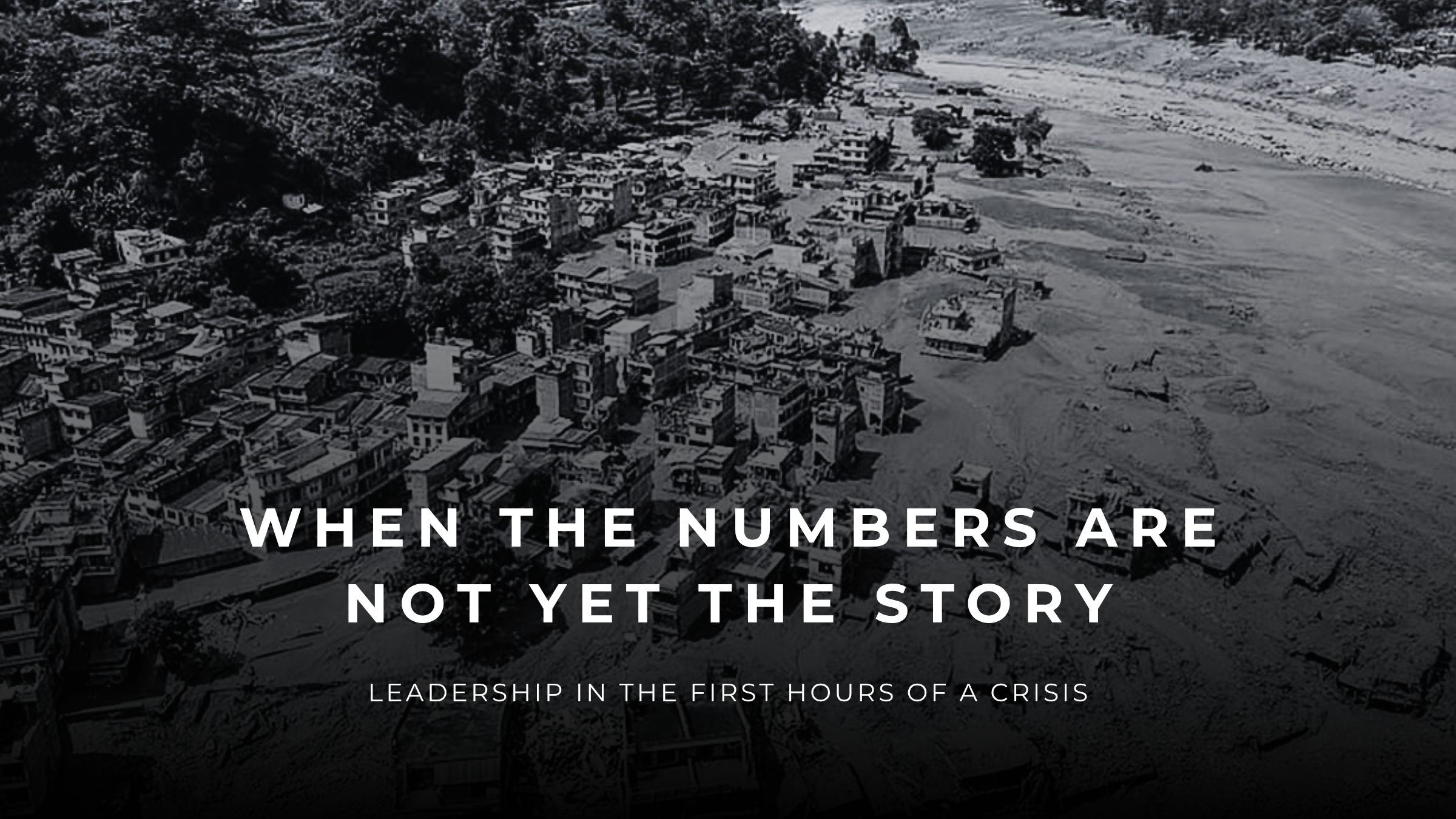
The leading headlines this morning are coming out of Nepal.
More than 150 people are confirmed dead.
Hundreds remain missing, including dozens of Australians. Entire communities have been swept away by a devastating flash flood and mudflow along the Nepal–Tibet border.
And as I read the reports, two things occupy my thoughts.
The first is how unreliable the early numbers in a disaster can be.
When the earthquake struck off Banda Aceh in 2004 and triggered the Indian Ocean tsunami, the initial reports spoke of people injured and lives lost. What followed would ultimately claim somewhere between 250,000 and 300,000 lives across countries throughout the region.
The early numbers were not the story.
They were simply the beginning of understanding what had happened.
That is one of the most difficult realities of responding to a major disaster. In the first hours and days, information is incomplete, communications are disrupted, access is difficult and people are reporting what they can see rather than what has actually happened.
The numbers can be too high.
They can be too low.
And they can change dramatically as search and rescue teams reach places that, only hours earlier, were inaccessible.
We are already seeing that uncertainty in Nepal. Entire roads, bridges and settlements have been destroyed, communications have been disrupted and the terrain itself is making access extraordinarily difficult.
The second thing I think about is the families.
For those with someone missing, the uncertainty is almost unbearable.
They are sitting thousands of kilometres away, watching the news, refreshing their phones and waiting for a message that may or may not come.
They don't know if their loved one is safe.
They don't know if they have been evacuated.
They don't know whether they are in a hospital, stranded somewhere without communications, or whether the worst has happened.
And in that absence of information, people do what people naturally do.
They fill the gaps.
They make assumptions.
They imagine possibilities.
When you are leading a response to a crisis, this is where the challenge becomes much greater than simply finding survivors or moving resources.
You are also managing uncertainty.
What does leadership look like in the first hours of a crisis?
In the initial hours and days, those leading the response will need to do several things simultaneously:
establish the facts before reacting;
create calm and clarity;
determine what requires immediate action;
communicate what is known — and what is not known;
establish ownership and accountability; and
keep communicating as the picture changes.
There is a natural human desire in a crisis to do something.
Anything.
Action feels better than uncertainty.
But action without understanding can create a second crisis.
The best leaders I have seen in these circumstances understand that their role is not to have every answer. Their role is to create enough clarity for people to know what happens next.
That distinction matters.
I have seen this during deployments to Bali, Thailand and Japan. I have seen what happens when the scale of an event is initially underestimated, when communications fail, when families desperately need information and when those leading the response are themselves trying to make sense of an unfolding situation.
Leadership in these moments is not about appearing to have all the answers.
It is about being prepared to say:
This is what we know.
This is what we don't know.
This is what we are doing.
And this is when we will update you again.
That kind of communication creates something incredibly valuable in a crisis: trust.
Why visible leadership matters in a crisis
And the presence of leaders matters.
People want to see that someone is taking responsibility. They want to know that someone cares. They want to know that the people making decisions understand the human consequences of those decisions.
This cannot simply be outsourced to a communications team.
The communications team has an important role, but leadership must be visible.
Because, eventually, the response will move through different phases.
Rescue.
Recovery.
Rebuild.
And while the first phase is measured in hours and days, the latter two can be measured in months and years.
That creates another leadership challenge.
What happens when the initial adrenaline disappears?
What happens when the cameras leave?
What happens when the rescue teams have gone home but communities are still living with what has happened?
What happens when fatigue begins to affect judgement and performance?
What happens when progress becomes painfully slow?
What happens when the objective remains the same but the circumstances have completely changed?
Resilience is collective
This is where resilience becomes more than an individual characteristic.
Resilience is collective.
It is created by the systems, relationships, leadership and sense of purpose that enable people to keep going when the immediate crisis has passed but the work is far from finished.
For those leading the response in Nepal, there will be enormous challenges ahead.
For the families waiting for news, there is a different challenge — one measured not in logistics or resources, but in uncertainty, fear and hope.
I have been fortunate to work alongside people responding to some of the world's most devastating disasters.
Bali.
Thailand.
Japan.
Each taught me something different about leadership, but perhaps the most enduring lesson is this:
In a crisis, people don't need leaders who pretend to have all the answers. They need leaders who are prepared to stand in the uncertainty with them.
My thoughts are with the people of Nepal, those working in the response, and every family waiting for news of someone they love.
For many of them, this morning is only the beginning of a very long journey.
Frequently asked questions
-
Crisis leadership is the ability to make decisions, communicate clearly and provide direction when circumstances are uncertain and the consequences are significant. It requires leaders to create calm and clarity without pretending to have information or answers they do not yet have. Peter Baines OAM explores these principles through his work on leadership under pressure.
-
In the initial hours and days of a crisis, leaders need to establish the facts before reacting, create calm and clarity, determine what requires immediate action, communicate what is known — and what is not known — establish ownership and accountability, and keep communicating as the situation changes. These are fundamental principles of leading through a crisis.
-
Clear communication helps people understand what is known, what is not known and what will happen next. In a crisis, consistent and honest communication can build trust, reduce uncertainty and help people make better decisions — principles that sit at the heart of effective leadership.
-
Leaders in a crisis rarely have the luxury of complete information. The challenge is to establish the facts that are available, identify what requires immediate action, communicate the uncertainty and continue to reassess decisions as new information emerges. This ability to make decisions under pressure is an important part of developing capable leaders.
-
Resilience is not simply an individual's ability to endure difficult circumstances. It is also collective — shaped by relationships, systems, leadership and a shared sense of purpose that enables people and organisations to keep going when the immediate crisis has passed. Peter Baines OAM explores resilience and leadership through his keynote and leadership work.
-
Disaster response teaches leaders about decision-making under pressure, communication, accountability, trust, resilience and the importance of visible leadership. Peter Baines OAM draws on his experience of international disaster response in Leadership Matters, exploring what these experiences can teach us about leading through challenging circumstances.